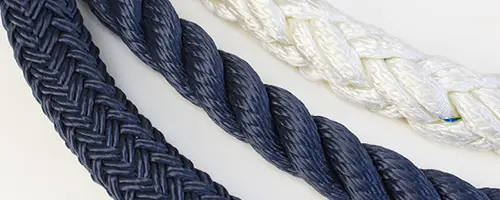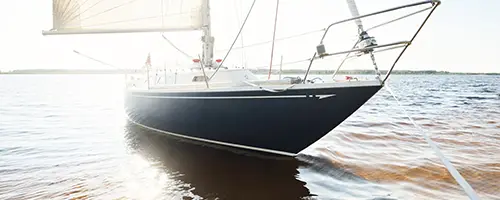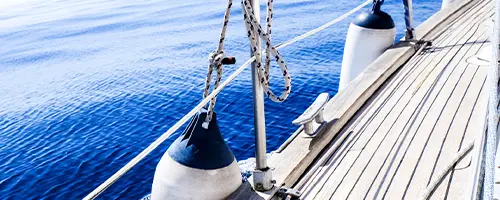
Mooring Warps Size Guide
General Guide for Determining the Diameter for Your Mooring Lines
These are the Important Decision Factors:
- Displacement-to-length ratio, i.e. is your yacht relatively light or heavy for her length?
- Monohull or Multihull – catamarans may be subject to additional windage and torsional stress
- Mooring Configuration, e.g., alongside, stern-to, fore-and-aft, or on a swinging mooring. N.B. The number of warps that share the load is a significant factor.
- Exposure, e.g. fetch, tide and chop.
Moorings can be broadly divided into three categories:
- Shoreside, e.g. Jetties, pontoons (fingers), piers, and harbour walls, but could also include any convenient tree or rock.
- Mooring alongside a fixed structure (along her length) with several lines to share the load and restrain her movement
- Mooring stern to (perpendicular to the shore) with stern mooring lines to the shore and utilising anchor lines deployed beyond her bow to maintain her angle to the shoreline
- Permanent Anchor Mooring: a permanent attachment to the seabed at a single fixed point or as part of a series.
- Swinging Mooring – A single mooring is generally a single anchor or weight laid on the seabed and connected to a buoy on the surface. A mooring attached to a series of anchors or weights on the seabed (also known as a trot) is still swinging if the connection is individual, i.e. it allows swing. Swinging refers to the fact that a yacht secured to a single point can turn a full circle in either direction, depending on the wind and tide. The buoy can be identifiable as a yacht’s home or a visitor’s mooring. Seabed mooring points vary from purpose-designed anchors to concrete weights, depending on local conditions. The sea bed anchor is typically attached to the mooring buoy with a chain known as the riser. A yacht is typically secured to the mooring buoy with a substantial, chafe-protected mooring rope, commonly referred to as a strop or bridle.
- Pile Mooring: poles driven into the bottom of the sea bed or river bed in a regular line, with their tops protruding the surface to a serviceable height. A yacht positions herself in line between two piles and deploys mooring lines fore and aft to a heavy steel ring on the pile, which may slide up and down with the tide.
- Running or Travelling: a fixed anchorage on the seabed with a block attached. A long line is reeved through the block, and each end leads back to the shoreline, where it is spliced together to form an endless loop. A rope is attached to the running rope to act as a riser. This type of mooring is commonly used for dinghies and tenders, which can be moored at a distance from the shore but are easily pulled back in for embarkation.
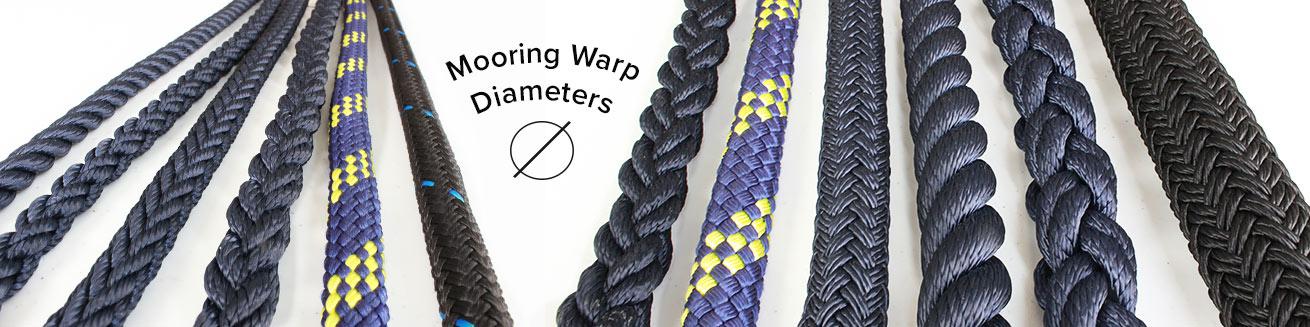
There are two significant factors in determining the adequate rope diameter for your mooring requirements:
- The risk factor of leaving your yacht unattended in all weather conditions.
- The number of lines deployed to handle the expected load.
1. Selection process for the diameter of General Use Mooring Lines (Shoreside):
- Find the column below that best represents your Boat Length Overall.
- Compare your displacement with the tonnage listed.
- If the displacement is greater than displayed in your column in the table, or the yacht is a multihull, consider moving across to the next column to increase the diameter.
- Have a good look at the mooring lines on neighbouring yachts with a critical eye and judge whether your setup should be the same or whether you can make improvements
- Take local conditions into account – some marinas are notorious for excessive movement (wave motion) when the wind is strong from a specific direction affording relatively little protection.
- Decide whether an upgrade would enhance your mooring convenience
- Add anti-chafe measures and compensators for peace of mind and fewer replacement costs
- Bear in mind that several correctly deployed mooring lines can share the overall strain – more mooring ropes should result in less load on each warp and, consequently, less shock impact on your deck fittings.
NB. Consider upsizing your Stern Mooring Lines when moored stern-to (Mediterranean style) because the strain on the ropes will be considerably greater than when your yacht is moored alongside a pontoon.
Consider doubling up your stern-to-mooring lines for Mediterranean-style mooring as a precaution, especially when leaving your yacht unattended for any length of time.
| Yacht Length Overall | < 6 metres | 6-8 metres | 8-10 metres | 10-12 metres | 12-14 metres | 14-16 metres |
|---|---|---|---|---|---|---|
| Approximate length in feet | < 20 feet | 20-26 feet | 26-33 feet | 33-40 feet | 40-46 feet | 46-53 feet |
| Displacement in Tonnes | 1 tonne | 2.5 tonnes | 5 tonnes | 9 tonnes | 13 tonnes | 16 tonnes |
| 3 Strand, Dockline, Octoplait Polyester | 8/10mm | 10mm | 12mm | 14mm | 16mm | 18mm |
| Anchorplait, Handy Elastic, 3 Strand Nylon | 8/10mm | 10mm | 12mm | 14mm | 16mm | 18mm |
| Moorex12 Polyester, 3 Strand Polypropylene | 12mm | 14mm | 16mm | 18mm | 20mm | |
| Octoplait Squareline Polypropylene | 14mm | 16mm | 18mm | 20mm |
| Yacht Length Overall | 16 – 18 metres | 18 – 22 metres | 22 – 26 metres | 26 – 30 metres | 30 – 36 metres | 36 – 50 metres |
|---|---|---|---|---|---|---|
| Approximate length in feet | 53 – 60 feet | 6- 72 feet | 72 – 85 feet | 85 – 98 feet | 98 – 118 feet | 118 – 164 feet |
| Displacement in Tonnes | 20 tonnes | 25 tonnes | 30 tonnes | 40 tonnes | 70 tonnes | 100 tonnes |
| 3 Strand / Octoplait Polyester | 18/20mm | 20/24mm | 24mm | – | – | – |
| Dockline | 18/20mm | 20/24mm | 24mm | – | – | – |
| Octoplait / Anchorplait Nylon | 18/20mm | 20/24mm | 24mm | – | – | – |
| Handy Elastic | 18/20mm | 20/24mm | 24mm | 28mm | – | – |
| Octoplait Squareline Polypropylene | 24mm | 28/32mm | ||||
| Super Yacht Mooring 01300 (Dockline) | – | – | 24mm | 28mm | 32mm | 36mm |
N.B. LIROS Super Yacht Mooring Line Article 01300 is the LIROS recommended dock line for yachts over 22 metres LOA
2. Selection process for a Single Point or a Double Point Mooring Configuration (Permanent Mooring):
- Single Point generally means a Swinging Mooring – N.B. Anchorplait/Octoplait 8 strand is recommended to prevent cockling
- Double Point could be, e.g. Fore and Aft between piles
- Find the column in the table below that best represents your Boat Length Overall.
- Compare your displacement with the tonnage listed.
- If the displacement is greater than displayed in your column in the table, or the yacht is a multihull, consider moving across to the next column to increase the diameter.
- Seek advice on local conditions and compare the benchmark size from the table below with other similar-sized boats moored in your area.
- Examine the mooring configurations on neighbouring yachts with a critical eye and assess whether your setup should be the same.
- Consider whether you can make any improvements in terms of mooring convenience and anti-chafe measures.
Benchmark Guide for Single Point Mooring Strops e.g. permanent home buoy swinging mooring
including Fore and Aft (double point) Mooring
3. Selection process for a Rope/Chain/Rope Bridle (Visitor Mooring):
- Find the column below that best represents your Boat Length Overall.
- Compare your displacement with the tonnage listed.
- If the displacement is greater than displayed in your column in the table, or the yacht is a multihull, consider moving across to the next column to increase the diameter.
- Consider the application for your bridle – Will it be used as a single or double mooring point or as an anti-chafe mechanism to protect your regular lines
- Consider the nature of the application – the chart is conservative and aimed at an overnight visit; consider upgrading to the next column for a more permanent arrangement or on an exposed mooring
Benchmark Guide for Rope / Chain / Rope Bridles
| Yacht Length Overall | 6 – 8 metres | 8 – 10 metres | 10 – 12 metres | 12 – 14 metres | 14 – 16 metres |
|---|---|---|---|---|---|
| Approximate length in feet | 20 – 26 feet | 26 – 33 feet | 33 – 40 feet | 40 – 46 feet | 46 – 53 feet |
| Displacement in Tonnes | 2.5 tonnes | 5 tonnes | 9 tonnes | 13 tonnes | 16 tonnes |
| Anchorplait / 3 Strand Nylon | 14mm | 16mm | 18mm | 20mm | 24mm |
| Chain | 8mm | 10mm | 10mm | 12mm | 12mm |